
Talks between Iran and the US in Pakistan concluded without a deal due to disagreements over key issues, including Iran's nuclear programme and sanctions, despite efforts to find common ground.

A media report indicates the White House was directly involved in crafting a social media post by Pakistan's Prime Minister Shehbaz Sharif, requesting then-US President Donald Trump to extend the deadline on Iran.
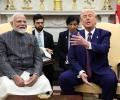
Prime Minister Narendra Modi and US President Donald Trump discussed the West Asia crisis and the importance of keeping the Strait of Hormuz open and secure. They also reviewed progress in bilateral ties and anticipated upcoming deals in the energy sector.

US President Donald Trump has claimed that a significant number of Iranian military officials were killed during a "massive strike" conducted in Tehran.

The question is whether the clocks allow enough time for two deeply mistrustful sides to get there, and whether the surface calm holds long enough for the paddling to produce something before the ceasefire ends on April 22, notes Prem Panicker in his must read blog on the Iran War.

Russian President Vladimir Putin has offered his support to help bring peace to West Asia, praising the Iranian people for their resilience. This comes as Iran seeks to resolve the conflict with the US, following discussions with Pakistani and Omani leadership.

Is the current rally telegraphing a durable peace plan in West Asia, boosted by United States (US) President Donald Trump's incoherent and contradictory posts on social media?

Amidst the stalling of high-level peace talks between Tehran and Washington, Iran continues to endure severe digital isolation as the nationwide internet blackout reached its 44th day on Sunday.

Iran has reiterated that key preconditions must be met before negotiations with the United States can begin to resolve the conflict in West Asia, including a ceasefire in Lebanon and the release of blocked Iranian assets.

The core issues to be settled -- access to Hormuz, Israel's aggression in Lebanon, the question of Iran's nuclear programme, sanctions relief and compensation -- are thorny enough to require weeks of patient negotiation. The most likely outcome of the opening sessions is that both sides take the measure of each other, establish what is and is not negotiable, and return home without having broken anything. That would count as progress.

In his first major national address since hostilities began, Trump said the ongoing military campaign, dubbed 'Operation Epic Fury', has delivered 'swift, decisive, overwhelming victories'.

Afghan Foreign Minister Amir Khan Muttaqi announced that Kabul will send diplomats to India as part of efforts to improve bilateral relations. He assured New Delhi that Afghan soil will not be used for activities detrimental to India's interests.

Pakistan is set to host face-to-face talks between the United States and Iran, aiming to solidify a fragile ceasefire and prevent further conflict in West Asia. The discussions will focus on a long-term peace arrangement, including sanctions relief, regional security, and Iran's nuclear program.
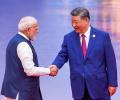
'When the Galwan incident took place, that was a big break in the trust factor between India and China.'

Srivastava warned that continued bombing of Iran by the US and Israel could severely undermine any prospects of reopening critical maritime routes through negotiation with Tehran.

'Was the five-day pause ever meant to hold, or was it simply another instrument of signaling, of positioning, of buying time in a war where even the pauses are tactical?' asks Prem Panicker in his must read daily blog on the Gulf War.

The US-Israeli military campaign, dubbed "Operation Epic Fury" by Washington, has entered its third day, with US President Donald Trump stating that operations would continue "until all of our objectives are achieved."

The ceasefire is still technically holding, to the extent that no overt hostilities have been reported yet, but the rhetoric has hardened dangerously. The week ahead will also clarify whether the Islamabad failure was a negotiating tactic or whether Washington has genuinely locked itself into a position from which the only exits are climb-down, escalation, or the slow bleed of a new status quo that nobody chose and nobody controls. Prem Panicker continues his must read blog on the Iran War.

Democratic Progressive Azad Party chairman Ghulam Nabi Azad expressed deep concern over the escalating conflict in the Middle East, urging restraint and diplomacy from all parties involved.
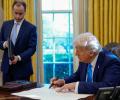
White House Press Secretary Karoline Leavitt noted that progress has been made in the Geneva talks with Iranian authorities, but the two nations stand 'far apart' on certain issues.

US President Donald Trump's threats against Iran have drawn strong condemnation from Democrat leaders, who are calling for his removal from office, while some Republicans express concern.

The US President clarified that these negotiations do not involve the new Supreme Leader, Mojtaba Khamenei.
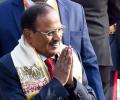
Both countries also committed to formalising cooperation on cybersecurity policy and information sharing on cybersecurity issues.
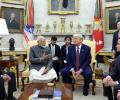
Prime Minister Narendra Modi and US President Donald Trump discussed the Middle East crisis, with a focus on the Strait of Hormuz.
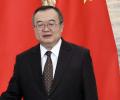
The 61-year-old senior diplomat was taken away for questioning in late July after returning to Beijing from an overseas work trip, the paper reported, quoting people familiar with the matter.

The United States, which entered this war in expectation of a short, sharp win along the Venezuela model, is now preparing for deeper involvement in a conflict it does not fully control, without the allies it typically relies on, against an adversary that is not behaving as expected, in a global environment that is already absorbing economic shock. Prem Panicker continues his must read daily blog on the Gulf War.

Highlighting the party's broader stance on international relations, he added, "Friends to all, malice to none."

'We are profoundly energy-dependent on the Gulf. That dependency must now be redirected towards the United States, because we require American permission to procure oil.' 'We additionally require Iranian permission to acquire oil from that source. So India now has to seek two separate permissions merely to secure its energy supply.' 'Should we be compelled to source from America, or from Venezuela -- which is, in effect, American-controlled supply -- that will inevitably carry a price premium, an elevated shipping cost, and a considerably extended delivery timeline, given the distances involved.'

What we are watching is something different: A fog manufactured and maintained by the people who started the war, so that the question of why it was started never has to be answered, observes Prem Panicker in his must read blog on the war in the Middle East.

'The people of Bangladesh have voted for a party that represents political interest.'
'It is a pro-Liberation party and it believes in the spirit of 1971, as opposed to the Jamaat-e-Islami, which was opposed to the Liberation struggle of Bangladesh in 1971.'

The question is no longer whether the war will expand. It has. The next few days will tell us whether the war stabilises around Hormuz or whether the Strait itself becomes the trigger for a far larger rupture. What to watch for over the next 48 hours is simple: Any move by the US toward direct naval control of the Strait; any credible Iranian attempt to disrupt or mine shipping lanes and, critically, whether energy infrastructure in the Gulf continues to be targeted.If those lines are crossed in tandem, the war will no longer be containable within the region.

Following the BNP's victory in recent elections, Bangladesh is seeking to reset its relationship with India, emphasizing mutual benefit and a recognition of the changed political landscape.

'Why are IPKF martyrs not being officially recognised and appropriately honoured? And is the government really changing its mind on this now?', asks Aditi Phadnis.
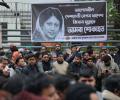
Former Indian envoys reflect on the life and legacy of Bangladesh's former Prime Minister Khaleda Zia, highlighting her role in restoring democracy and the complex relationship between India and Bangladesh during her tenures.

Indian strategic affairs experts criticize the US strike on Venezuela and the capture of President Nicolas Maduro, warning of a 'bad precedent' and potential for similar actions by other powers.

The SC has gone a step further to state that even if one were to not apply the codified GAAR provisions, the judicial GAAR would continue to apply, point out Pranav Sayta and Bhargav Selarka.

Around 100 artistes heralded the parade, on the theme 'Vividata Mein Ekta (Unity in Diversity) that featured a grand presentation of musical instruments, demonstrating the nation's unity and rich cultural diversity.

Prime Minister Narendra Modi was conferred with the Order of Oman by Sultan Haitham bin Tarik for his contribution to India-Oman ties and his leadership.

Omar Abdullah states that normalisation of relations with Pakistan is difficult due to terror incidents and lack of a credible civilian partner in Islamabad.

President Donald Trump has withdrawn the United States from over 60 international organisations, including United Nations bodies and the India-France-led International Solar Alliance, calling the institutions 'redundant' and 'contrary' to America's interests.
